How Does Weather Affect Distribution Center Operations?
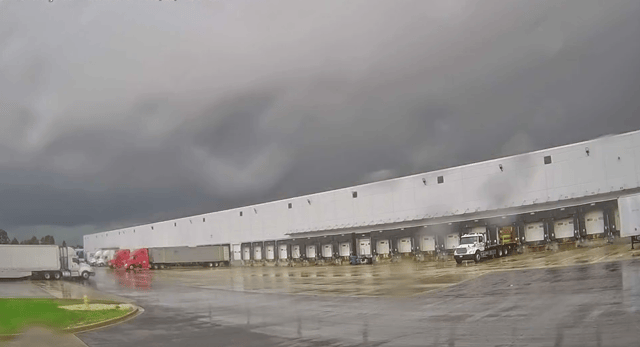
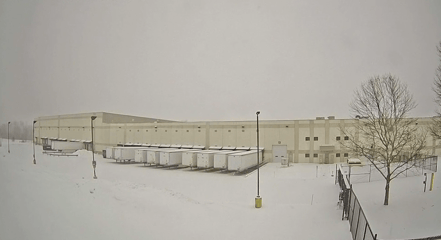
Almost every weather hazard that matters to a distribution center shows up outdoors: in the yard, on the dock, in the parking lot, or on the road in and out. The building itself is rarely the problem. The work happening around it is.
Each condition below maps to a specific operational decision someone has to make, usually under time pressure, usually with trucks waiting.
How Can Weather Monitoring Improve Distribution Center Safety?
General weather awareness does not change behavior. Defined thresholds do. The difference between a facility that reacts well and one that reacts late is usually whether the trigger was written down and measured on site, rather than judged in the moment by whoever happened to be looking outside.
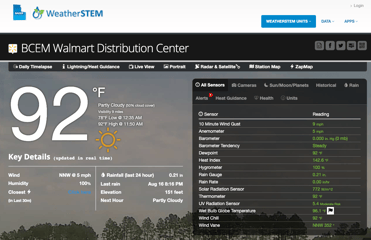
A monitoring system earns its place when it turns a measurement into a decision:
When
Lightning is detected within a defined radius of the facility
Then
Suspend outdoor operations, clear the yard and docks, hold until all-clear
When
Temperature or WBGT reaches a defined heat threshold
Then
Implement heat procedures: work/rest cycles, hydration, acclimatization checks
When
Wind speed reaches an operational threshold
Then
Restrict lifts, elevated work and affected trailer and container handling
When
Rainfall rate or accumulation exceeds a defined threshold
Then
Evaluate flooding, dock approach conditions and site access routes
Set once, applied identically at every shift, on every site, whether or not the most experienced supervisor is on the clock. That is what makes a decision defensible after the fact, and it is the difference between a weather product and an operational decision-support system.
Thresholds only work if they're measured where the work happens
A threshold tied to a regional observation is only as good as the distance between that sensor and your yard. Tied to a station on your own property, it reflects the conditions your people are actually standing in.
What Weather Conditions Should Distribution Centers Monitor?
Most facilities need the same core set. Priorities shift by geography. A Gulf Coast DC weights tropical and lightning heavily, and an upper-Midwest facility weights winter and wind, but the instrument list is largely consistent.
Lightning
Real-time detection with automated alerts at a defined radius, and an all-clear when the threat has passed. The single most common trigger for stopping and restarting yard work.
Temperature & Heat Stress
Temperature, humidity, heat index and WBGT where worker heat exposure is a concern for yard crews, dock staff and drivers.
Rainfall
Accumulation and intensity in real time, so flooding and site-access decisions are based on what actually fell on your property.
Wind
Speed, gusts and direction, particularly for lifts, elevated work, trailer handling and anything with a sail area in the yard.
Severe Weather
Situational awareness and alerting for thunderstorms, tornadoes, hurricanes and other hazards, integrated with National Weather Service products.
Air Quality
Worth adding where a facility has specific exposure concerns, such as wildfire smoke seasons or nearby industrial activity.
Why Isn't a Weather App Enough for a Distribution Center?
It is the difference between a forecast and a measurement.
OSHA makes this same distinction explicitly, in the context of heat. Its heat hazard recognition guidance notes that "the potential error increases with distance from the weather station," and that weather reports cannot account for "the heat generated by fires, hot tar or other materials, ovens, or other hot equipment, or heat-absorbing surfaces such as roads and roof surfaces." It adds that some worksites are hotter because of "structures that block air movement," and that water, metal or other materials can reflect sunlight onto workers. OSHA's recommendation is direct: "Workplace environmental heat should be measured on-site."
Source: OSHA, Heat Hazard Recognition (osha.gov/heat-exposure/hazards)
A distribution center yard is a textbook version of every one of those factors: acres of asphalt and concrete, metal trailers reflecting sun, buildings blocking airflow, and running equipment adding heat. And the logic extends well past heat. Lightning, wind and rainfall all vary across short distances too.
The question a DC manager is actually asking
Not: "Thunderstorms are possible in Atlanta this afternoon."
But: "Lightning is approaching this facility and our outdoor operations need to respond right now."
A forecast cannot answer the second question. A station on your roofline can.
How Can Distribution Centers Automate Weather Alerts?
Nobody has the staffing to assign someone to watch a radar loop through a shift. Automation means the system watches the thresholds and notifies people only when a threshold is actually crossed, and, just as importantly, when it is safe to resume.
Alerts that fire on your conditions
- Lightning alerts at a defined radius, with escalating notice as strikes close in
- High wind alerts at the speed where your operations actually change
- Temperature thresholds tied to your cold-weather and hot-weather procedures
- Heat index and WBGT thresholds tied to work/rest and hydration policy
- Heavy rainfall at the rate or accumulation that signals a drainage or access problem
- Severe weather warnings for tornado, severe thunderstorm and tropical products affecting your site
- All-clear notifications so operations restart on a rule, not a guess
Routed to the people who act on them
An alert that reaches the wrong person is the same as no alert. Notifications route by role and by site, so each group gets what it needs to act:
Where a facility needs to reach people who are not looking at a phone, such as a yard crew, spotters, or drivers on the lot, the same trigger can drive an outdoor warning siren and voice message through Blast, and a visible on-site display through Bright. Hardware and software from the same system, on the same threshold, so there is no gap between what the sensor sees and what the yard hears.
How Weather Monitoring Supports Distribution Center Continuity
Weather is not only a safety problem. It is an operations problem, and it propagates. A distribution center is a chain of dependent steps, and weather can interrupt any one of them:
NOAA's National Centers for Environmental Information makes essentially this point about the sector as a whole, noting that logistics and shipping organizations use its information "to reduce risks that can cause costly delivery disruptions or endanger workers and the general public," and observing that with tens of millions of packages due for delivery each day, "a single delay causes ripple effects for many businesses and citizens."
Source: NOAA NCEI, Logistics and Shipping (ncei.noaa.gov/about/our-impact/logistics-shipping)
On-site monitoring supports the decisions on either side of that ripple:
Built for Distribution Center Operations
One weather monitoring system for the entire facility: sensors on your property feeding one platform, one set of thresholds, and one alert path to every team that needs to move.
One System, End to End
From the sensor on your roofline to the decision on the dock floor
On-Site Weather Station
Installed and maintained at your facility. Lightning, temperature, humidity, WBGT, wind, rainfall and pressure, with optional camera and air quality.
Real-Time Conditions
Live facility data streaming continuously to a dashboard your operations, EHS and security teams can all see, on any device.
Automated Alerts
Your thresholds fire notifications, and can drive a Blast outdoor warning siren and Bright on-site display so the yard hears and sees it too.
Operations, EHS & Security
The right roles are notified at the right site, with an all-clear when conditions clear, so restart is as disciplined as shutdown.
Faster, More Defensible Decisions
Every trigger and every reading is timestamped and retained, so what you did and why is documented for audits, claims and reviews.
For a single facility, that is one station and one alert plan. For a national network, it is the same system replicated across sites and rolled into one mesonet view, so a corporate EHS director can see every location at once while thresholds stay tuned to each site's geography.
Installed and managed for you
Weatherstem handles siting, installation, calibration and ongoing maintenance. There is no sensor for your maintenance team to own, no spreadsheet to keep, and no separate vendor to manage when something needs attention. See the Protect station, camera and alerting package.
Where We Already Operate
Weatherstem operates more than 900 stations nationwide, including at distribution and logistics sites for some of the largest operators in the country.
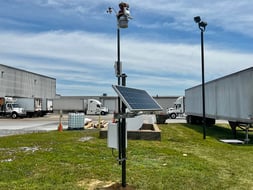
National Distribution Operator
A Weatherstem station on a distribution facility, delivering site-level conditions to the operations and EHS teams working the yard and docks.
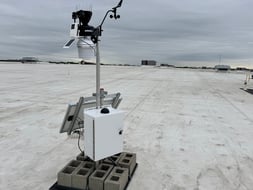
Amazon Facilities
On-site monitoring supporting outdoor operations at Amazon facilities, where yard and dock activity runs continuously across shifts.
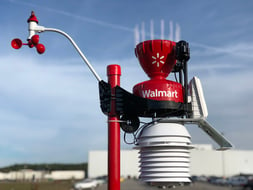
Walmart Distribution Center
A Weatherstem station operating at a Walmart distribution center, providing facility-level conditions for the teams working the yard and docks.
Client names are referenced to describe where Weatherstem stations operate. Weatherstem is not affiliated with, endorsed by, or sponsored by these companies.
Go Deeper on Distribution Center Weather Safety
Four detailed guides on the hazards that most often disrupt distribution center operations, and what a monitoring program should do about each.
Heat & WBGT
Warehouse Heat Safety
Heat stress in warehouse and yard environments, how heat index and WBGT differ, and where measured thresholds fit into a heat illness prevention program.
Read the guide →
Lightning
Distribution Center Lightning Safety
Building a lightning policy for dock and yard operations: detection radius, suspension triggers, shelter, and the all-clear rule for restarting work.
Read the guide →
Severe Weather
Severe Weather and Distribution Centers
Tornadoes, damaging wind, hail and tropical systems: shelter execution, staged shutdown, and continuity planning across a distributed network.
Read the guide →
Monitoring
On-Site Weather Monitoring for Distribution Centers
What on-site monitoring actually measures, how it differs from regional data, and how to scope a program for one facility or a national network.
Read the guide →