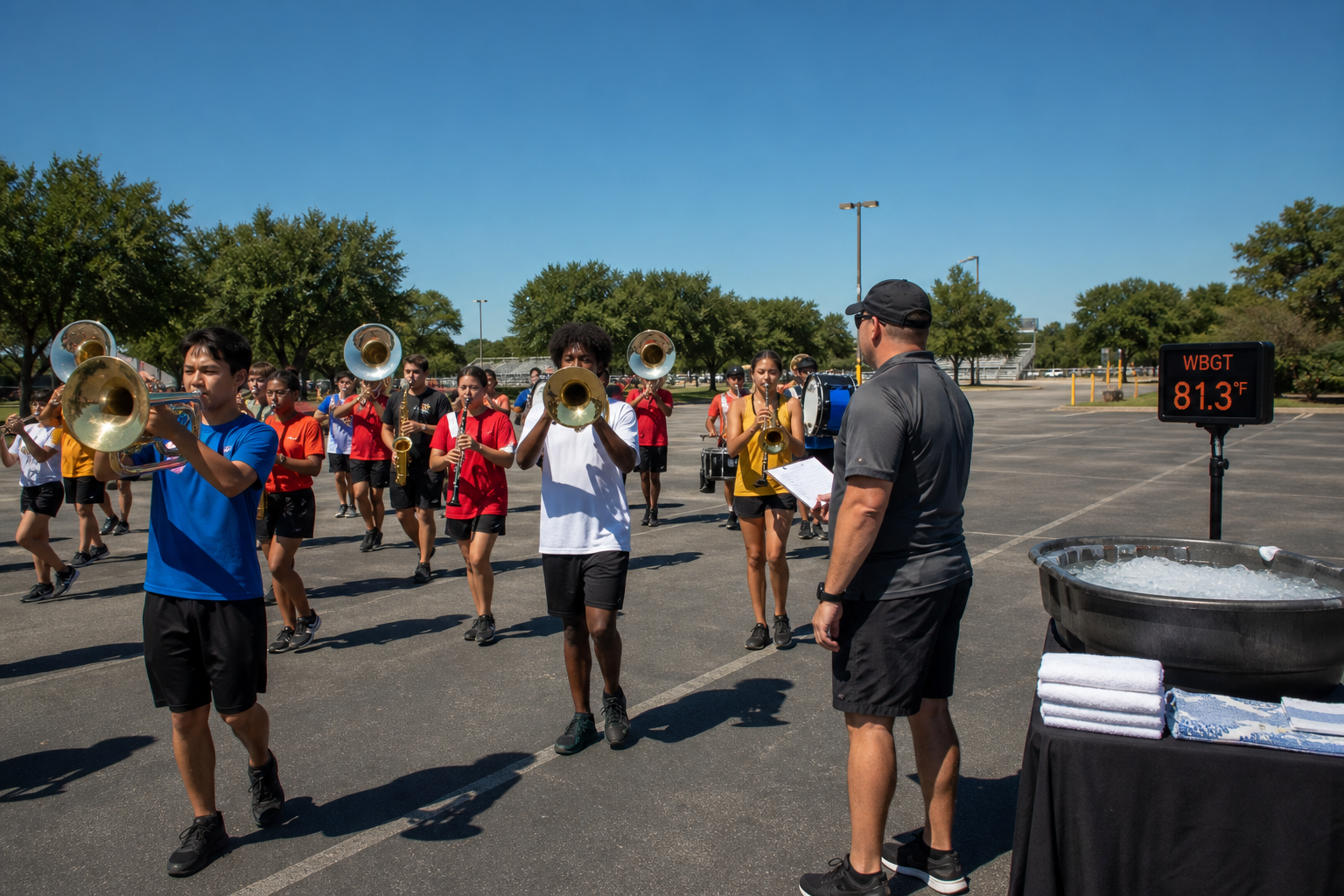
When schools talk about the UIL heat rule, the conversation almost always starts with football. But the requirement is not written for football. It is written for outdoor activity, and that includes marching band. The students rehearsing on an open asphalt lot in August are covered by the same rule, and in some ways they are the group most exposed to it.
The UIL WBGT requirement covers outdoor marching band, not just athletics. Same readings, same cooling-zone trigger, same emergency action plan.
Why band is often the higher-risk group, not the lower one
Band rarely gets the same heat infrastructure as athletics, yet the exposure can be worse. Rehearsals run long. Students stand on open pavement that radiates heat upward. Uniforms, instruments, and equipment add load. And many band programs do not have an athletic trainer on site the way a football practice does. In 2025, a high school band in Mississippi had multiple students hospitalized for heat illness during a preseason rehearsal. The risk is real, and it is not hypothetical.
What the rule requires for band
The same standard that applies to athletics applies to band:
- WBGT monitored on site, with readings before and every 30 minutes during rehearsal.
- A rapid cooling zone with cold-water immersion available at the trigger, 79.7°F in Class 2 or 82°F in Class 3 and above.
- An emergency action plan that explicitly covers band, not just athletics.
- Unrestricted access to water, and rest breaks with real hydration.
- Readings recorded and kept on file.
What directors should do before band camp
- Confirm who is responsible for taking and recording WBGT at every rehearsal site.
- Make sure a cooling zone is staged and someone is trained to use it.
- Check that your campus emergency action plan names band activities.
- Build the reading and record routine into rehearsal before the first hot day, not during it.
How Weatherstem helps
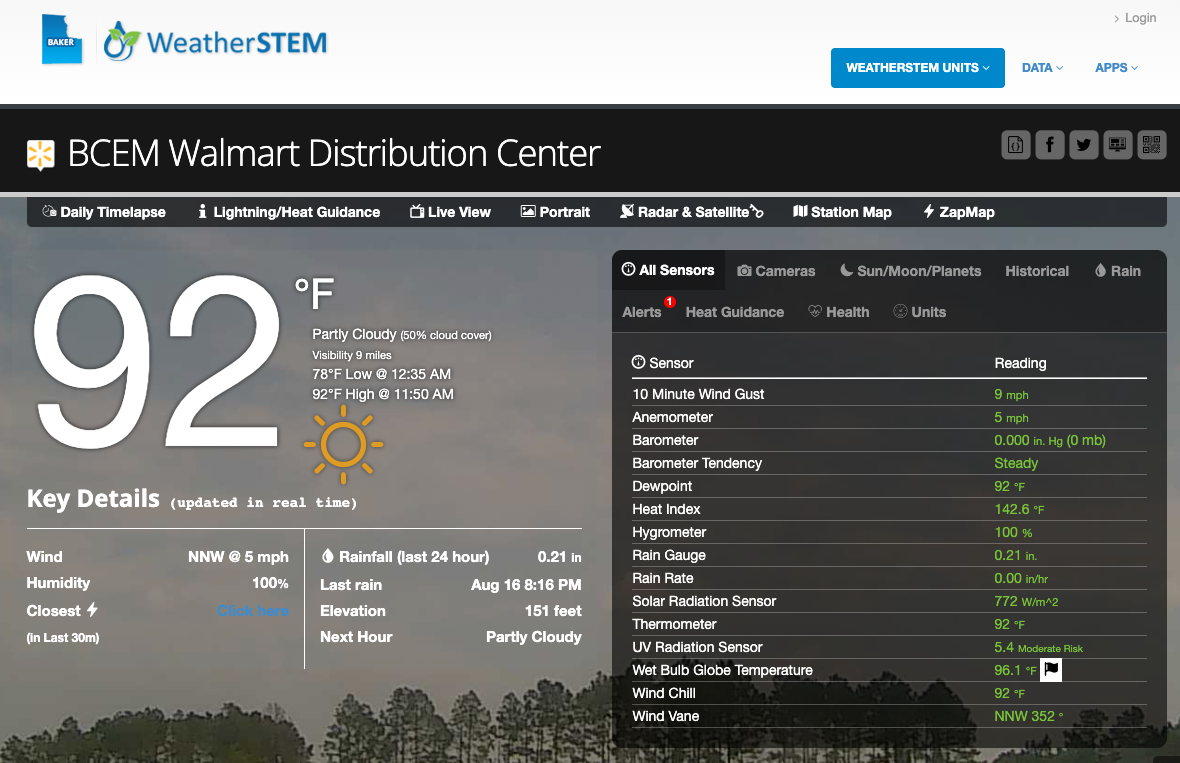
Weatherstem already operates stations across Texas, including at the University of Texas, Texas A&M, and Texas Motor Speedway, and more than 900 nationwide. An on-site station reads WBGT at the rehearsal lot, logs every reading automatically, and alerts staff when conditions cross into the next band, so the same protection athletics expects is in place for band without adding a manual job to a director's day.
Frequently asked questions
Does the UIL heat rule really apply to marching band?
Yes. The WBGT requirement applies to outdoor marching band activities alongside athletics, including the cooling-zone and record-keeping requirements.
Does band need a cooling zone too?
Yes. A rapid cooling zone with cold-water immersion must be available at 79.7°F in Class 2 or 82°F in Class 3 and above, the same trigger as athletics.
What if our band has no athletic trainer?
The requirement still applies. The school is responsible for monitoring, cooling, and records at every outdoor site, which is exactly why many programs use a fixed station rather than relying on staff availability.
Read the full Texas UIL WBGT mandate guide, see the exact activity thresholds, or check where every state stands on the heat mandate tracker.
Weatherstem is not affiliated with or sponsored by the University Interscholastic League. References to the UIL are for informational purposes only.