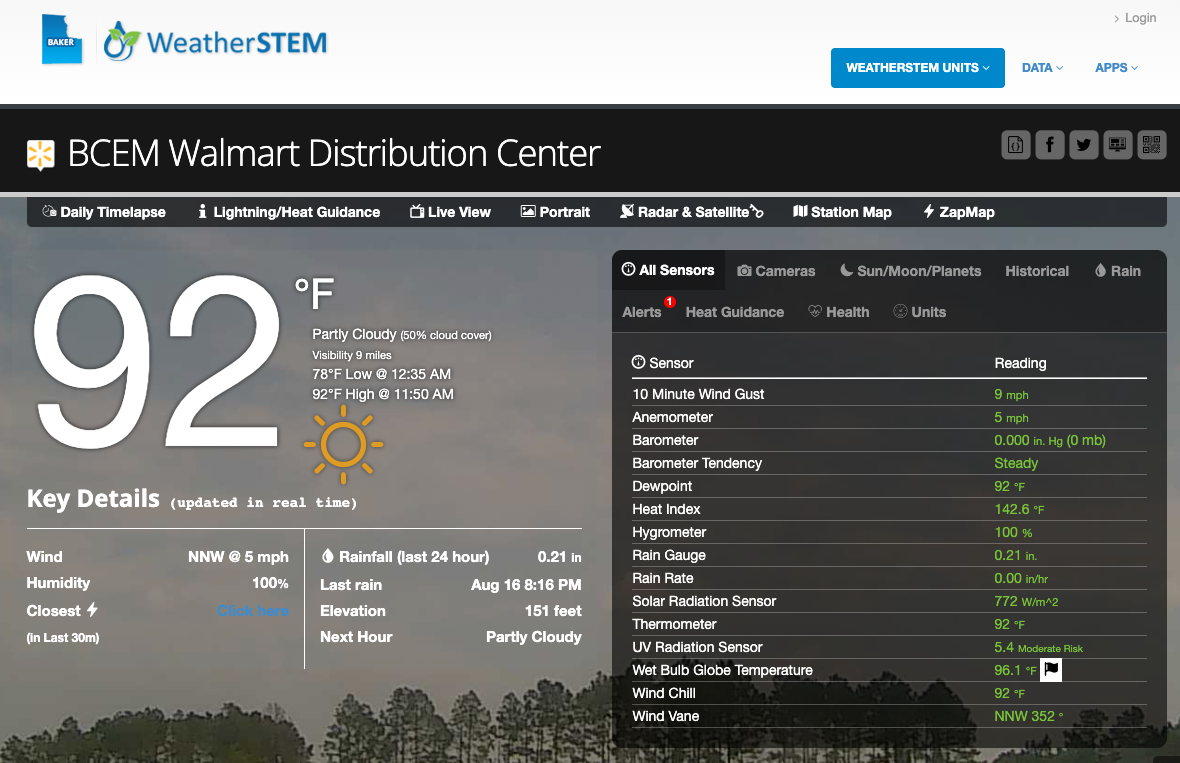
If you have ever seen a heat index in the low 90s and then watched an athlete struggle on a field that felt far hotter, you have run into the limits of the heat index. WBGT exists to close that gap.
What WBGT actually measures
Wet bulb globe temperature combines four environmental factors into a single number: air temperature, humidity, wind, and solar radiation. It uses three sensors, each capturing part of the picture.
- Natural wet bulb: a thermometer with a wet wick exposed to the air, showing how well sweat can actually cool the body.
- Black globe: a sensor inside a black sphere that absorbs radiant heat, capturing direct sun and the cooling effect of wind.
- Dry bulb: a standard shaded air-temperature reading.
Outdoor WBGT = 0.7 x natural wet bulb + 0.2 x black globe + 0.1 x dry bulb. Humidity carries the most weight, because evaporative cooling is what keeps an athlete safe.
How it differs from the heat index
The heat index uses only air temperature and humidity, and it is calculated for shade. That makes it fine for general awareness, but it leaves out the two things that matter most to someone exercising outdoors: direct sun and wind. There is also the surface. Turf and asphalt absorb sun and radiate it back upward, which is why a reading taken on the field can run meaningfully hotter than the airport number on an app. WBGT's globe sensor captures that radiant load. The heat index cannot.
Why athletic associations adopted it
The American College of Sports Medicine built its activity guidelines around WBGT because it is the better predictor of exertional heat illness for people working in the sun. As state associations have moved from heat-awareness suggestions to enforceable rules, WBGT has become the standard the rules are written against, including the new Texas requirement. When an association tells you to monitor heat, it increasingly means WBGT specifically, not the heat index.
Why a phone app is not the same thing
Apps that report WBGT estimate it from the nearest available weather data. That estimate can be close, or it can miss, depending on how far the source is from your field and how different your surface and exposure are. A measurement taken at the activity site, in the same sun and over the same surface as the students, reflects their actual risk. For a rule that asks you to record readings and act on them, the difference matters.
Weatherstem also turns the same science into a 14-part WBGT lesson on its learning platform, so students can understand the number that governs their own practices. You can see the WBGT lesson here.
How Weatherstem measures it
Weatherstem already operates stations across Texas, including at the University of Texas, Texas A&M, and Texas Motor Speedway, and more than 900 nationwide. A station at the activity site measures WBGT in the same sun and over the same surface as the students, updates continuously, and logs every reading automatically, with heat sitting alongside lightning and severe-weather alerting on one dashboard.
Frequently asked questions
What is the difference between WBGT and the heat index?
The heat index uses only air temperature and humidity and is calculated for shade. WBGT adds direct sun and wind, the conditions an athlete actually faces on an open field, so it is a better measure of heat stress during outdoor activity.
Can a phone app measure WBGT accurately?
An app estimates WBGT from the nearest available weather data, which may differ from your field. A device or station at the activity site gives the most accurate reading for that location.
Why does the playing surface matter?
Turf and asphalt absorb and radiate heat, raising the load on athletes standing on them. WBGT captures that radiant heat through its globe sensor, which is why a field reading can be higher than a nearby shaded or airport reading.
Ready for the numbers? See the Texas WBGT activity thresholds, or read the full Texas UIL WBGT mandate guide.
Weatherstem is not affiliated with or sponsored by the University Interscholastic League. References to the UIL are for informational purposes only.

Weatherstem provides real-time weather monitoring, lightning detection, and automated alerting systems for emergency management, government agencies, athletics programs, and commercial operations. 900+ stations deployed nationwide.
Weatherstem
Real-time weather monitoring built for compliance and life-safety decisions.
Professional hardware, dual lightning detection, automated alerts, and permanent data logging — installed and managed for you. Used by emergency management agencies, athletic programs, and government operations nationwide.
Book a Free Demo