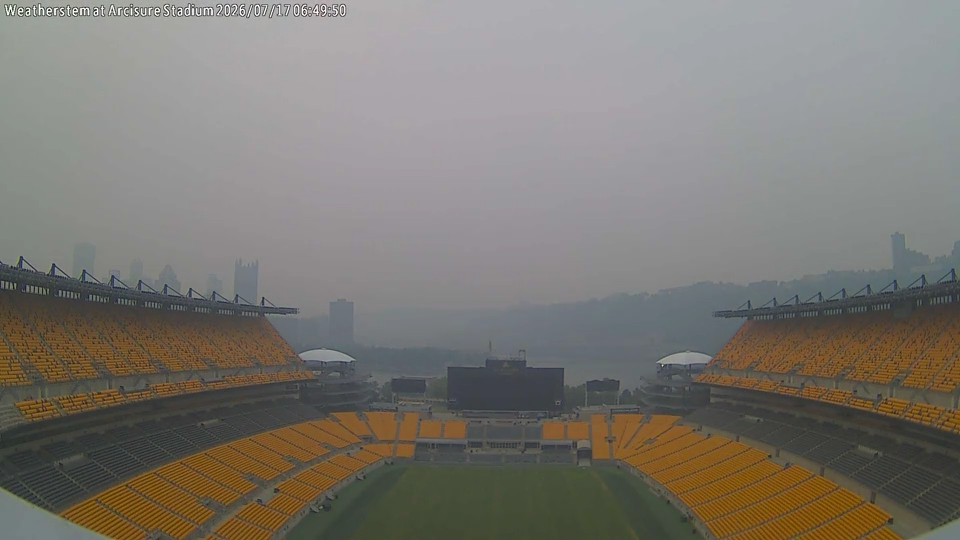
Wildfire smoke, seasonal haze, and regional pollution events have made air quality a regular part of athletic operations planning. But two terms often get used interchangeably, and shouldn't be: AQI and PM2.5. Understanding the difference (and how they relate) helps athletic departments make faster, more confident decisions about practices, games, and outdoor activity.
What Is AQI?
AQI, or the Air Quality Index, is a standardized scale used to communicate how clean or polluted the air is, and what health effects might be associated with that air, at a given time. Developed by the EPA, it translates raw pollutant measurements into a single, easy-to-understand number ranging from 0 to 500+.
That number is paired with a category (Good, Moderate, Unhealthy for Sensitive Groups, Unhealthy, Very Unhealthy, and Hazardous) along with a corresponding color, so decision-makers can quickly gauge risk without needing to interpret raw pollutant data themselves.
AQI is useful precisely because it simplifies a complex mix of pollutant data into something actionable. A coach, athletic trainer, or administrator doesn't need to know the exact concentration of fine particulate matter in the air to understand that "Unhealthy" means outdoor activity should be modified or postponed. That clarity is what makes AQI such a widely adopted tool for public communication and operational decision-making.
What Is PM2.5?
PM2.5 refers to fine particulate matter measuring 2.5 micrometers or smaller in diameter, roughly 30 times smaller than the width of a human hair. Because these particles are so small, they can be inhaled deep into the lungs and, in some cases, enter the bloodstream.
PM2.5 comes from a variety of sources: vehicle exhaust, industrial emissions, construction dust, and combustion of any kind. One of the most significant contributors in recent years has been wildfire smoke. When vegetation burns, it releases enormous quantities of fine particulate matter into the atmosphere, which can travel hundreds or even thousands of miles from the source fire. This is why regions far from an active wildfire can still experience elevated PM2.5 levels and hazy skies.
Athletes are particularly susceptible to the effects of elevated PM2.5 during strenuous activity. Exercise increases both the rate and depth of breathing, often shifting from nasal to mouth breathing, which bypasses some of the body's natural filtration and allows more particulate matter to reach the lower respiratory tract. This makes monitoring conditions especially important for outdoor practices, competitions, and conditioning sessions.
What Is the Difference Between AQI and PM2.5?
While related, AQI and PM2.5 serve different purposes. A simple way to think about it:
| AQI | PM2.5 |
|---|---|
| Risk index | Actual particulate concentration |
| Easier for communicating conditions | More direct measurement |
| Can incorporate multiple pollutants | Specifically measures fine particles |
| Useful for operational thresholds | Useful for identifying particulate pollution |
In short, AQI is a communication tool built for quick, broad understanding, while PM2.5 is a specific, measurable quantity that reflects one component of overall air quality, often the most relevant one during wildfire smoke events.
How Is PM2.5 Used to Calculate AQI?
PM2.5 concentration is one of the key inputs used to calculate the AQI, but it isn't a one-to-one conversion. The EPA uses breakpoint tables that translate measured PM2.5 concentrations (in micrograms per cubic meter) into a corresponding AQI value and category. Without getting too deep into the math, the relationship isn't linear: small changes in concentration can produce larger jumps in AQI at certain thresholds.
It's also important to understand that AQI isn't simply "the PM2.5 number" relabeled. AQI can be calculated from several different pollutants, including ground-level ozone, PM10, carbon monoxide, sulfur dioxide, and nitrogen dioxide, in addition to PM2.5. The reported AQI at any given time reflects whichever pollutant has the highest calculated value. This means that on a given day, AQI might be driven primarily by ozone rather than particulate matter, or vice versa. During wildfire smoke events, PM2.5 is typically the dominant factor, but that isn't always the case.
Should Athletic Departments Monitor AQI or PM2.5?
The short answer: both, depending on the operational need.
- AQI is best suited for communication and decision-making. Its standardized categories make it easy to set clear thresholds (for example, modifying outdoor activity when AQI reaches "Unhealthy for Sensitive Groups") and to communicate those thresholds to coaches, athletes, and families.
- PM2.5 is best suited for understanding the specific particulate conditions driving air quality, particularly during wildfire smoke events when fine particulate matter is the primary concern.
- Real-time, on-site measurements of both give athletic departments the most complete and current picture, rather than relying solely on regional estimates or forecasts.
Used together, AQI and PM2.5 data give athletic departments both the big-picture risk assessment and the underlying detail needed to make informed, defensible decisions. For more on how wildfire smoke specifically affects air quality and athletic operations, see our wildfire smoke article.
Why Does Local Air Quality Data Matter for Athletic Events?
Regional AQI reports, the kind typically found on national air quality websites or apps, are useful, but they're often based on monitoring stations that can be miles away from a given campus or athletic complex. That distance matters. Air quality can vary meaningfully across relatively small geographic areas, especially in the presence of localized smoke, dust, or emissions sources.
Conditions can also differ across a single campus or athletic complex depending on proximity to roads, elevation, wind patterns, and even the orientation of nearby buildings. A regional AQI reading of "Moderate" doesn't guarantee that every field, court, or track on a campus is experiencing the same conditions.
This is why on-site air quality measurements provide such valuable situational awareness. Rather than relying solely on the nearest regional monitor, athletic departments equipped with local monitoring can see real-time, location-specific data and make decisions based on the actual conditions their athletes are training and competing in. To learn more about setting up this kind of monitoring, see our athletic department monitoring article.
What is the difference between AQI and PM2.5?
AQI is a standardized index used to communicate overall air quality risk, while PM2.5 is a direct measurement of fine particulate matter concentration in the air. PM2.5 is one of several inputs used to calculate AQI.
Should athletic departments monitor AQI or PM2.5?
AQI is useful for communication and setting operational thresholds, while PM2.5 helps identify the specific particulate conditions driving air quality, especially during wildfire smoke events.

Weatherstem
Real-time weather monitoring built for compliance and life-safety decisions.
Professional hardware, dual lightning detection, automated alerts, and permanent data logging — installed and managed for you. Used by emergency management agencies, athletic programs, and government operations nationwide.
Book a Free Demo