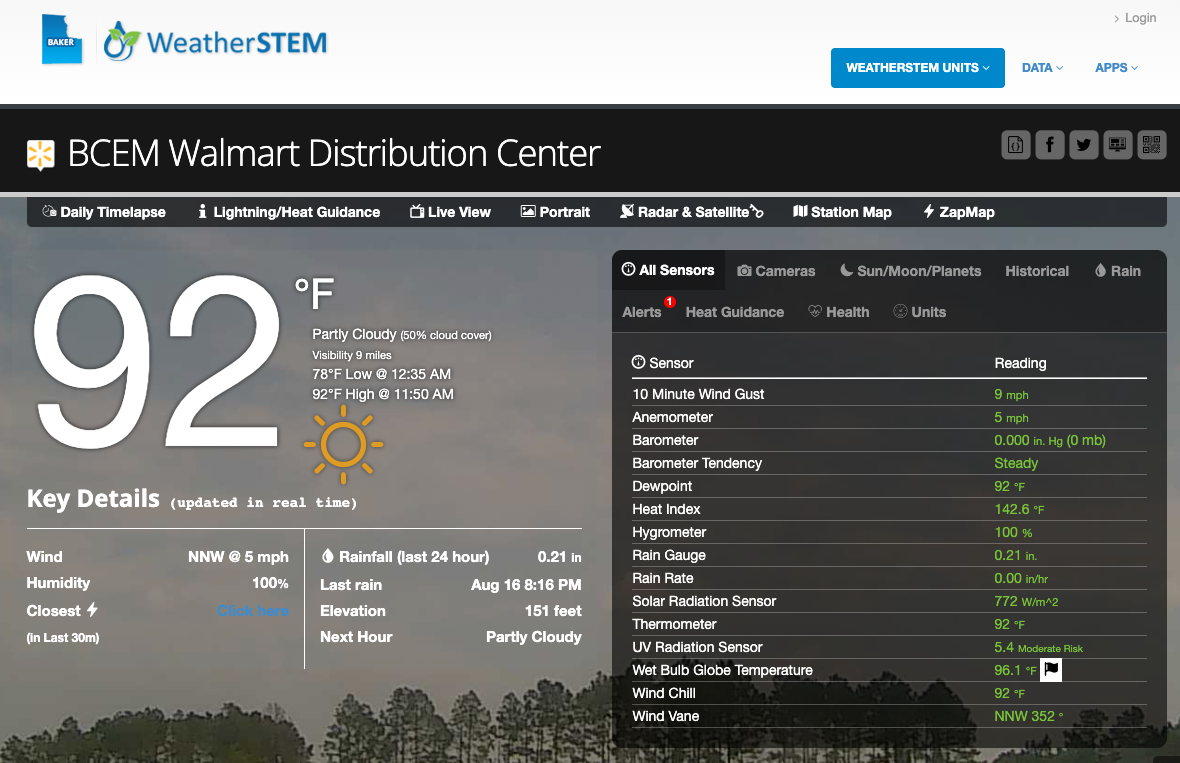
What is Heat Index?
Heat index combines air temperature and relative humidity into a single "feels like" number, originally developed for the general public rather than for workplace safety. Because it appears in most weather apps and forecasts, heat index is familiar and easy to access. That makes it a practical starting point for organizations developing a heat safety program.
What is WBGT?
Wet Bulb Globe Temperature is a more comprehensive measure used widely in occupational and athletic settings. It accounts for temperature, humidity, wind speed, and solar radiation, giving a more accurate picture of the heat stress a person actually experiences while working outdoors in direct sun. Measuring WBGT requires a dedicated WBGT sensor that captures the environmental factors used in the calculation.
What are the Key Differences Between Heat Index and WBGT?
The biggest difference is that heat index assumes shaded conditions with light wind, while WBGT accounts for the additional heat stress caused by direct sunlight and air movement. As a result, heat index can meaningfully understate the heat stress experienced by a worker performing strenuous activity in full sun with little or no wind. WBGT captures that additional environmental load, which is why occupational health organizations like NIOSH and ACGIH build their exposure guidance around it rather than heat index.
It is common for heat index and WBGT to differ because they measure different aspects of the environment. Heat index estimates how hot it feels based on air temperature and humidity, assuming shaded conditions. WBGT incorporates additional environmental factors such as solar radiation and wind speed, which can significantly increase or decrease heat stress depending on the work environment. As a result, two worksites with the same air temperature may have very different WBGT values.
The chart below compares air temperature, heat index, and WBGT throughout a hot day in Bowling Green, Kentucky. Notice how each metric responds differently as environmental conditions change.
Which Heat Safety Metric Do Regulators Prefer?
OSHA's proposed federal heat standard is built around heat index for initial triggers, with WBGT referenced as an acceptable and more precise alternative. Several state standards, including California's and Oregon's, explicitly allow or require WBGT for high-exertion, direct-sun work. In general, heat index is the accessible baseline; WBGT is the more defensible, higher-precision standard.
How Should Employers Choose Between Heat Index and WBGT?
For indoor or shaded work, heat index is often a reasonable proxy. For outdoor crews doing sustained physical labor in direct sun like construction, roadwork, landscaping, and athletics, WBGT gives a materially more accurate trigger point and is worth the investment in proper sensors. Many organizations monitor both, using heat index for general situational awareness and WBGT to guide operational decisions for higher-risk outdoor work.
Frequently Asked Questions
Is heat index or WBGT better for workplace heat safety?
Heat index is a useful starting point for general heat awareness because it combines temperature and humidity into an easy-to-understand value. WBGT provides a more complete measure of heat stress because it accounts for additional factors such as solar radiation, wind, temperature, and humidity, making it better suited for high-risk outdoor work.
Does OSHA use heat index or WBGT?
OSHA's proposed federal heat standard uses heat index as the primary trigger metric while recognizing WBGT as a more precise alternative. Many occupational health organizations use WBGT when evaluating heat exposure for workers performing strenuous outdoor activities.
Why is WBGT important for outdoor workers?
WBGT provides a more accurate picture of heat stress for workers exposed to direct sunlight, physical exertion, and changing environmental conditions. It helps employers make better decisions about rest breaks, work modifications, and heat safety procedures.
Explore Other Heat Safety Compliance Articles
Use the articles below to go deeper on any part of your heat safety program, from the regulations themselves to industry-specific guidance:
- Heat Safety Compliance and Weather Monitoring Guide
- OSHA Heat Safety Requirements Explained
- How to Build a Heat Illness Prevention Plan
- How Weather Monitoring Supports OSHA Heat Compliance
- Heat Safety for Construction Companies
Learn how Weatherstem helps organizations monitor heat conditions in real time with site-specific weather data and automated alerts that support safer operational decisions. Contact Weatherstem to learn more. Contact Weatherstem to Learn More.

Weatherstem provides real-time weather monitoring, lightning detection, and automated alerting systems for emergency management, government agencies, athletics programs, and commercial operations. 900+ stations deployed nationwide.
Weatherstem
Real-time weather monitoring built for compliance and life-safety decisions.
Professional hardware, dual lightning detection, automated alerts, and permanent data logging — installed and managed for you. Used by emergency management agencies, athletic programs, and government operations nationwide.
Book a Free Demo