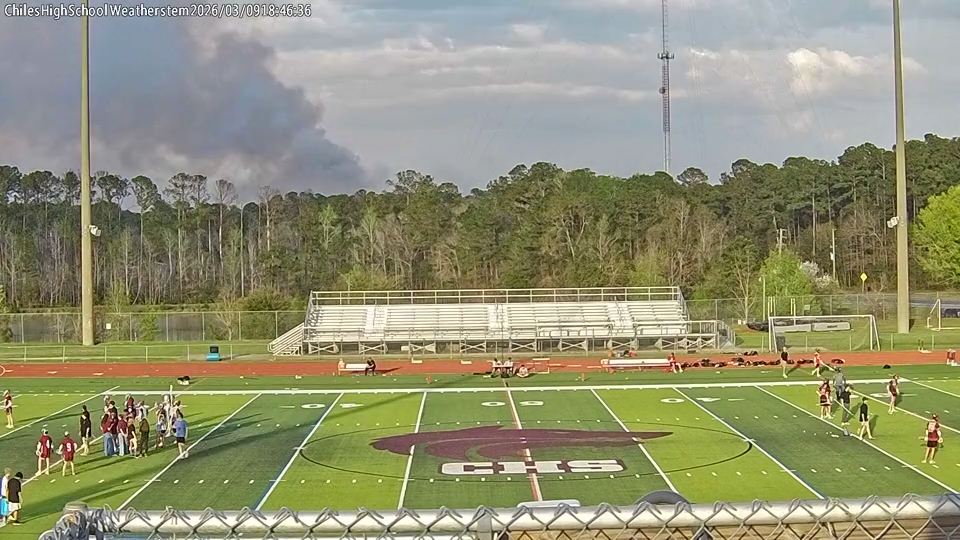
Wildfire smoke has become a recurring challenge for school athletic programs across large parts of the country. Smoke plumes routinely travel hundreds of miles from active fires, turning clear skies hazy and forcing last-minute decisions about practices and competitions. Athletic directors, coaches, and administrators need clear, practical ways to evaluate risk and protect student-athletes. The Air Quality Index (AQI) is the most widely available tool for those decisions, but it works best when schools understand what it measures, how smoke behaves, and how activity intensity and duration change the equation.
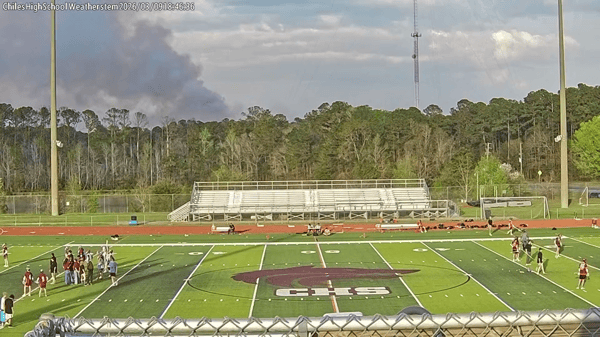
How Does Wildfire Smoke Affect Outdoor Sports?
Wildfire smoke is not limited to communities next to active fires. Prevailing winds can carry fine particles hundreds of miles, affecting regions that have no local fire activity. Conditions can also shift rapidly. A morning with acceptable air quality can deteriorate by afternoon as a smoke plume arrives or stagnates under a temperature inversion.
Athletes face higher exposure than people who are resting or walking. During vigorous exercise, ventilation rates increase dramatically. Athletes breathe harder and deeper, pulling more air (and more particles) into the lungs. Children and adolescents may also face greater concern because they breathe more air relative to their body size and often participate in prolonged periods of vigorous outdoor activity. Even short-term exposure during high-intensity activity can trigger coughing, reduced lung function, chest tightness, or asthma symptoms in sensitive individuals. These effects are not theoretical and appear regularly during major smoke events that reach school fields far from any fire line.
Why Does PM2.5 Matter During Wildfire Smoke
Wildfire smoke is dominated by fine particulate matter known as PM2.5, particles 2.5 micrometers or smaller in diameter. These particles are small enough to penetrate deep into the lungs and, in some cases, enter the bloodstream. They are the primary driver of the health effects associated with smoke: airway irritation, reduced lung function, cardiovascular stress, and aggravated asthma or other chronic conditions.
During wildfire smoke events, elevated AQI values are typically driven by PM2.5. AQI tells athletic staff how the measured pollutant concentration translates into a standardized health-risk category. PM2.5 provides the underlying concentration measurement for fine particulate matter. Understanding this relationship helps athletic staff interpret the numbers correctly. A moderate AQI driven by ozone has different health considerations than the same AQI driven by PM2.5 from wildfire smoke, particularly during prolonged outdoor exertion. For a clearer comparison of how AQI and PM2.5 measurements relate, see our related article on AQI vs. PM2.5.
Because PM2.5 concentrations can change quickly with wind and fire behavior, a single morning reading is rarely sufficient for an afternoon or evening event.
What AQI Is Safe for Outdoor Sports?
The U.S. Environmental Protection Agency’s Air Quality Index translates measured pollutant concentrations into a simple 0–500 scale with six color-coded categories:
- Good (0–50, Green): Air quality poses little or no risk. Outdoor sports can proceed normally.
- Moderate (51–100, Yellow): Acceptable for most people, though unusually sensitive individuals may notice mild effects.
- Unhealthy for Sensitive Groups (101–150, Orange): People with heart or lung conditions, children, and older adults may experience health effects. The general public is less likely to be affected, but prolonged or intense outdoor exertion raises risk.
- Unhealthy (151–200, Red): Everyone may begin to experience effects; sensitive groups face more serious impacts.
- Very Unhealthy (201–300, Purple): Health alert. Risk increases for the entire population.
- Hazardous (301+, Maroon): Emergency conditions; everyone is more likely to be affected.
EPA AQI categories are health-risk categories, not universal athletic participation rules. There is no single AQI value that universally determines whether a school athletic event should proceed. The appropriate response depends on the AQI category, pollutant, activity intensity, duration, athlete population, and applicable organizational guidance. A short warm-up is different from a full soccer match or a cross-country race. High-intensity continuous activity creates greater exposure than intermittent or lower-intensity sports. Schools with athletes who have asthma or other respiratory conditions may choose more conservative thresholds based on their population and applicable guidance.
The most effective approach is for each athletic department to establish a written operational threshold in advance. That policy should specify actions (continue with modifications, move indoors, postpone, or cancel) based on AQI range, activity type, expected duration, and the presence of sensitive athletes. Having the policy in writing removes ambiguity on game day and supports consistent communication with coaches, parents, officials, and opposing schools.
How Can Athletic Departments Monitor Air Quality on Game Day?
Effective monitoring combines preparation with real-time awareness:
- Pre-event monitoring: Check forecasts and current conditions the day before and again the morning of the event. Sources such as AirNow.gov, state air-quality agencies, and reliable local sensor networks provide the baseline picture.
- Continuous monitoring: Smoke conditions can worsen or improve within hours. Assign someone to check AQI at regular intervals (for example, every 1–2 hours) leading up to and during the event.
- Alerts: Set up notifications from trusted sources so staff receive updates without constant manual checking.
- Multiple locations: Air quality can vary across a campus or between fields even a few miles apart. Check readings closest to the actual competition or practice site rather than relying solely on a regional monitor.
- Indoor vs. outdoor considerations: Moving indoors is often the preferred mitigation, but only if the facility has adequate filtration. Buildings with inadequate filtration, open doors or windows, or significant outdoor air infiltration may not provide the protection staff assume. Confirm indoor air quality when possible rather than assuming it is automatically safe.
Combining official monitors with a network of local sensors (where available and properly calibrated) gives a more complete picture than any single source.
When Should Schools Modify or Postpone Outdoor Activities?
Decisions become clearer when thresholds and procedures are set before smoke arrives:
- Establish activity-specific thresholds in a written policy so coaches and administrators are not improvising under pressure.
- Monitor trends rather than reacting to a single snapshot. A rising AQI that is still in the moderate range may warrant earlier modifications than a stable reading at the same level.
- Factor in forecast smoke movement and meteorological conditions. An approaching plume or stagnant air mass changes the risk profile even if the current number looks acceptable.
- Communicate decisions consistently and early. Parents, opposing schools, officials, and athletes need clear notice with the rationale (current and expected AQI, activity type, and policy reference).
- Document conditions and the decision process. Recording the AQI readings used, the time of the decision, and the rationale creates a documented record of how the decision was made and can help refine the policy over time.
An athletic department may choose to begin limiting intensity, shortening sessions, moving to indoor alternatives, or postponing non-essential outdoor activity when AQI reaches the Unhealthy for Sensitive Groups range, particularly for younger athletes or those with known respiratory conditions. At Unhealthy levels and above, programs may consider cancellation or relocation for prolonged or high-intensity events. Any thresholds should be aligned with applicable school, district, state, or governing-body guidance.
The goal isn't to eliminate every outdoor activity when smoke is present. It is to give athletic staff a consistent, documented process for determining when conditions are acceptable, when activities should be modified, and when they should be postponed or relocated.
Schools that treat air-quality decision-making as a standing operational procedure can better manage health risks while maintaining as much of the competitive and developmental calendar as conditions safely allow. The combination of understanding smoke behavior, knowing what AQI and PM2.5 actually represent, monitoring continuously, and following a pre-established written threshold gives athletic departments the practical tools they need for safer game-day decisions.
What AQI is safe for outdoor sports?
There is no single AQI value that universally determines whether outdoor sports should proceed. Athletic departments should consider the AQI category, pollutant, activity intensity, duration, athlete population, and applicable school, district, state, or governing-body guidance.
How does wildfire smoke affect athletes?
Wildfire smoke contains fine particles such as PM2.5 that can penetrate deep into the lungs. Vigorous exercise increases breathing rates and the amount of air athletes inhale, potentially increasing exposure and aggravating respiratory symptoms in sensitive individuals.
Should schools monitor AQI during outdoor sporting events?
Yes. Air quality can change rapidly as smoke moves or conditions change. Monitoring current conditions and trends before and during an event can help athletic staff determine whether conditions remain within their established operational thresholds.
Want to see how real-time, site-specific weather and air-quality monitoring can support athletic safety decisions? Talk with Weatherstem

Weatherstem
Real-time weather monitoring built for compliance and life-safety decisions.
Professional hardware, dual lightning detection, automated alerts, and permanent data logging — installed and managed for you. Used by emergency management agencies, athletic programs, and government operations nationwide.
Book a Free Demo